
DNA Fragmentation Testing

When you’re looking for answers about your fertility, a semen analysis is an important place to start.
It can tell us a lot.
But there’s something a standard semen analysis doesn’t directly measure: the DNA carried inside the sperm.
That’s where sperm DNA fragmentation testing can give us another piece of the fertility picture.
Every sperm carries DNA—half of the genetic information needed to create an embryo.
That DNA is carefully packaged inside the sperm. Sometimes, breaks or damage can occur within the genetic material. This is called sperm DNA fragmentation.
Higher levels of sperm DNA fragmentation have been associated with infertility and miscarriage.
But here’s something that may be surprising:
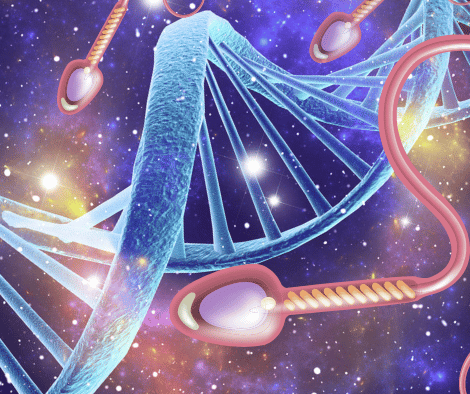
A standard semen analysis and a sperm DNA fragmentation test are looking at different things.
A semen analysis looks at characteristics such as sperm count, movement and shape.
Sperm DNA fragmentation testing looks more deeply at the integrity of the genetic material the sperm carries.
That means someone can have a semen analysis that appears normal while still having elevated sperm DNA fragmentation—something MCRM has included in its male-factor education for years.
There isn’t always one clear reason.
Sperm DNA fragmentation may be associated with factors such as:

Having one of these risk factors doesn’t automatically mean sperm DNA fragmentation is elevated. And an elevated result doesn’t necessarily tell us why the DNA damage occurred.
It gives your fertility team another piece of information to consider.
Pregnancy loss is complex, and there are many possible causes.
For a long time, much of the investigation following pregnancy loss has focused on the person carrying the pregnancy.
But an embryo receives genetic material from both the egg and the sperm.
Research has found an association between elevated sperm DNA fragmentation and miscarriage. And in 2026, the American Society for Reproductive Medicine updated its guidance on recurrent pregnancy loss to give sperm DNA fragmentation a more defined place in the evaluation.

ASRM now says sperm DNA fragmentation testing may be considered when recurrent miscarriage remains unexplained or when recurrent pregnancy loss occurs along with infertility.
This does not mean that sperm DNA fragmentation causes every miscarriage.
It also doesn’t mean that everyone who experiences a pregnancy loss needs DNA fragmentation testing.
It means there may be another place to look when you and your fertility team are searching for answers.
An elevated result is information—not a prediction.
It doesn’t mean you can’t achieve a healthy pregnancy.
And it doesn’t automatically mean sperm DNA fragmentation is the reason you’ve experienced infertility or pregnancy loss.
Your fertility specialist will look at the result alongside your semen analysis, medical and reproductive history, your partner’s evaluation when applicable, and other relevant testing.
If your DNA fragmentation is elevated, your physician may also recommend additional evaluation of male reproductive health, including consultation with a reproductive urologist.

Sperm DNA fragmentation may be receiving new attention because of the updated ASRM guidance, but this testing isn’t new to MCRM.
MCRM has recommended sperm DNA fragmentation testing when clinically appropriate since 2013.
And testing is available on-site at both MCRM office locations, helping keep this part of your evaluation connected to your fertility care team.
Not every patient needs every fertility test.
But when the usual answers don’t seem to explain what’s happening, sometimes it makes sense to look a little deeper.
If you’re experiencing infertility or recurrent pregnancy loss, ask your MCRM fertility specialist whether sperm DNA fragmentation testing may be appropriate for you.
A standard semen analysis can tell us a lot. Sometimes, looking deeper can tell us more.
This information is provided for educational purposes and does not replace individualized medical advice. Your physician can recommend testing based on your individual medical and reproductive history.