
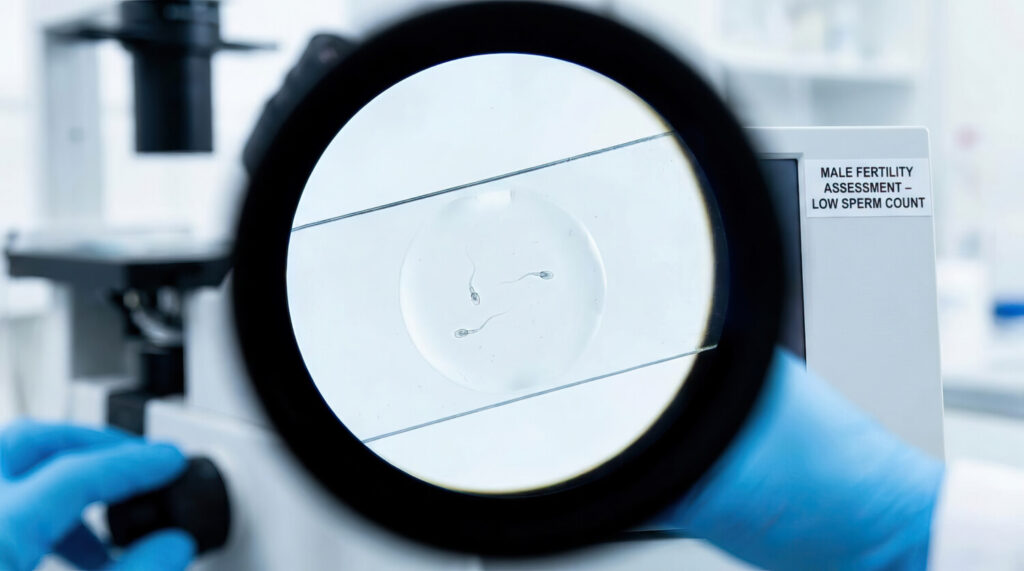
Azoospermia means no sperm are found in the ejaculate. The American Society for Reproductive Medicine (ASRM) estimates that azoospermia affects about 1% to 2% of all men and about 10% of men who are having trouble conceiving, so you’re far from alone. The hopeful part is that many men with azoospermia go on to have biological children with today’s treatments.
A zero sperm count result can catch you completely off guard, and whatever you’re feeling right now makes sense. We’re so glad you’re here. At MCRM Fertility, our team will sit down with you, and with your partner if you have one, walk through every option together and make sure your next steps feel clear.
What Is Azoospermia?
A zero sperm count means no sperm were found when your sample was examined. One result is a starting point, and there’s still so much to learn. Your MCRM specialist will repeat the semen analysis to confirm the result before making a plan with you, alongside a physical exam and bloodwork.
Obstructive vs. Nonobstructive Azoospermia
Azoospermia has two types. According to ASRM’s guide to surgical sperm retrieval, about 40% of cases come from a blockage, and the rest come from a problem with sperm production. Your type will guide every step that follows, and both types have paths forward.
Obstructive Azoospermia
In obstructive azoospermia, the testicles make sperm, but a blockage keeps those sperm from reaching the ejaculate. A past vasectomy or a congenital absence of the vas deferens, the tube that carries sperm, can cause this kind of blockage.
Nonobstructive Azoospermia
In nonobstructive azoospermia, sperm production itself is affected. Common causes include:
- Genetic conditions such as Klinefelter syndrome
- Hormonal causes
- Chemotherapy or radiation
- Testosterone or anabolic steroid use, which shuts down the body’s own signals for making sperm
Many of these causes are outside your control, and each one gives our team clear next steps to explore with you. Many men are surprised to learn that testosterone supplements can decrease sperm production, and the good news is that cause can often be addressed.
Azoospermia Causes and the Testing That Comes Next
You’ll be in caring, experienced hands. Our team, led by Medical Director Dr. Mira Aubuchon, includes board-certified reproductive endocrinologists and andrologists with advanced training, and our male fertility specialists will work alongside you to find the cause of your azoospermia. Your MCRM specialist will start with a repeat semen analysis and a physical exam, then order hormone bloodwork, including follicle-stimulating hormone (FSH).
FSH is often elevated with nonobstructive azoospermia and usually falls in the expected range when a blockage is the cause, and either result simply points your team toward the right plan. When your history points to a genetic cause, your specialist may also recommend:
- Y chromosome microdeletion testing
- A chromosome test (karyotype) to check for Klinefelter syndrome
- Cystic fibrosis transmembrane conductance regulator (CFTR) gene testing if a blockage such as an absent vas deferens is suspected
Genetic testing can feel daunting, and your specialist will explain each step of your male fertility testing and what every result means for you.
Azoospermia Treatment Options at MCRM
The right path will depend on your type of azoospermia, the cause and your family-building goals. Our team will talk through every option with you, and we’ll choose the path that feels right together.
Hormone Treatment
When testosterone or anabolic steroid use is the cause, stopping use and taking medications such as clomiphene citrate can help restart sperm production. For most men, sperm return within about six months after stopping, though recovery looks different for everyone. Our specialists will walk you through male infertility medication options openly and without judgment.
Surgical Sperm Retrieval
When sperm are made but can’t reach the ejaculate, or are made in very small numbers, a surgeon, often a reproductive urologist, can retrieve sperm directly from the testicle or the epididymis. Common retrieval techniques include:
- Testicular sperm extraction (TESE), which retrieves sperm from the testicle
- Microsurgical TESE (micro TESE), which has higher sperm retrieval rates than the conventional method
- Microsurgical or percutaneous epididymal sperm aspiration (MESA or PESA), which collects sperm from the epididymis
Retrieved sperm can be used fresh or frozen for later use, and our team will coordinate your care from retrieval through treatment, so you’ll never have to figure out the next step on your own.
IVF With ICSI
Retrieved sperm are used with in vitro fertilization (IVF) and intracytoplasmic sperm injection (ICSI), one of the biggest advances in fertility treatment. During ICSI, an embryologist injects a single sperm directly into each egg, so only a small number of sperm are needed. ICSI can improve the chances of pregnancy when very few sperm are available, which is welcome news for many men with azoospermia.
Our embryology lab offers advanced sperm selection for ICSI, including techniques that help our embryologists choose the most mature sperm. Our team will guide you through each step of IVF at MCRM.
Donor Sperm
Learning that donor sperm may be part of your path can be hard to hear, and you may need time with that news. Donor sperm from a known or anonymous donor is another loving path to parenthood, and the family you build will be just as much yours. Through donor-assisted IVF, our team will move at your pace, answer every question and support you with the same care on every path you choose.
Can a Man With Azoospermia Have a Baby?
Yes, and there is so much reason for hope. Surgical sperm retrieval with IVF and ICSI gives many men with azoospermia the chance to have a biological child, some causes can be treated directly, and donor sperm offers another way to build your family.
Our financial counselors will also help you plan for costs, with resources for affording treatment that include PatientFi payment plans.
Azoospermia FAQ
What causes azoospermia?
Azoospermia is caused by a blockage that keeps sperm from reaching the ejaculate or by a problem with sperm production. Production problems can come from genetic, hormonal, medical or medication-related causes.
Can azoospermia be temporary?
Sometimes. When testosterone or anabolic steroid use is the cause, sperm return within about six months for most men after stopping, sometimes with the help of medication.
Can azoospermia be misdiagnosed?
A single semen analysis is a starting point, so your specialist will repeat the test to confirm the result before making a plan with you.
Is there a cure for azoospermia?
Some causes, such as a blockage or a hormonal cause, can be treated directly. For many other men, sperm retrieval with IVF and ICSI offers a path to parenthood.
Schedule a Male Fertility Evaluation at MCRM
An azoospermia diagnosis is a lot to process, and you don’t have to carry it alone. Facing it on your own can make it feel even heavier. There’s no shame in asking for help, and reaching out is the first step toward finding your way forward. We’re here for you every step of the way.
When you’re ready, request an appointment with our team in St. Louis or Tulsa. We’ll listen, answer your questions and help you find the path to parenthood that fits your family.