
Is Egg Freezing Right for You?
Deciding whether to freeze your eggs is deeply personal, and there’s no single right moment to start exploring it. At MCRM Fertility, we see egg freezing as more than a medical procedure.
Freezing your eggs is a gift you give your future self, a way to stay proactive and keep your options open on your own timeline. Whether you’re weighing your career, waiting for the right partner, or facing a medical treatment that could affect your fertility, we’re here to walk through how egg freezing works and what applies to your specific situation.
Every person’s reasons for freezing their eggs are different, and there’s no single checklist that applies to everyone. Age is one factor, since egg quality and quantity naturally decline over time, but it’s far from the only one.
Where you are on your path toward parenthood counts for just as much. Some people freeze their eggs while focused on a career or education, others while waiting for the right partner, and others simply because they want more time before deciding.
A medical treatment that could affect your fertility, like chemotherapy or radiation, can also shift the timeline, as can a family history of early menopause or other genetic factors. If you want a fuller breakdown of how these factors interact, Timing Is Everything walks through age, readiness, and medical timing in more depth.
For now, know that whatever brought you here, egg freezing exists to give you that option, on your terms.
How Does Egg Freezing Work?
So how does egg freezing work? The process starts with a consultation, where your care team reviews your health history and orders baseline testing, including bloodwork and an ultrasound to check your ovarian reserve, the number of eggs available to work with during a given cycle.
This consultation is also where you’ll talk through your goals directly with your care team, so the stimulation plan they build reflects your specific situation and goals.
Ovarian stimulation comes next. You’ll self-administer injectable hormone medications for about 10 to 14 days. These medications encourage your ovaries to develop multiple eggs during the cycle, more than the single egg your body releases in a typical month. Your care team will teach you how to self-inject, and typically, the first shot is the only one that feels difficult.
Your care team monitors your progress with blood work and ultrasounds every few days throughout stimulation, tracking how your follicles are developing and adjusting your medication dose in response, so your plan adjusts to how your body is responding as your cycle progresses.
Once your follicles reach the right size, you’ll take a trigger injection to complete the final stage of egg maturation. Egg retrieval follows about 36 hours later, a short outpatient procedure done under sedation, about 15 to 20 minutes, and you’ll go home the same day. From there, the rest of the day is yours to rest and feel good about the proactive step you’ve just taken for your future.
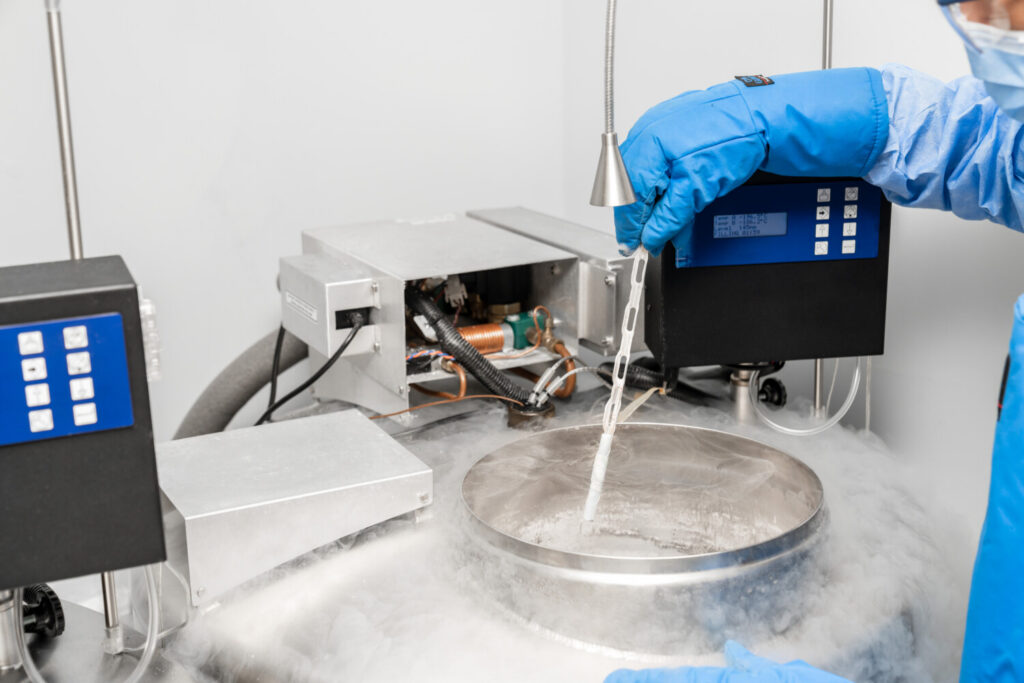
After retrieval, MCRM’s embryology team freezes your eggs within hours using vitrification, the same rapid-freezing technology the American Society for Reproductive Medicine recognizes as standard practice for preserving egg quality. Vitrification locks in your eggs at their current quality, and modern storage allows them to remain viable for many years, so they’ll be ready whenever you decide and are ready to use them.
Behind that lab work is a team with more than 50 years of combined experience in reproductive medicine. MCRM’s reproductive endocrinologists, a reproductive gynecologist, embryologists, and advanced practice providers work together on every cycle, building your plan around your specific ovarian reserve, response, and goals.
What the Egg Freezing Process Involves, Step by Step
Understanding the full picture, from possible risks to what day-to-day life looks like, can help you feel prepared going in.
Monitoring for OHSS During Egg Freezing
One known but uncommon risk your care team watches for during the egg freezing process is ovarian hyperstimulation syndrome (OHSS), a reaction to the stimulation medications that can cause ovarian swelling and fluid buildup. According to ASRM, moderate-to-severe OHSS occurs in about 1 to 5 percent of IVF cycles.
MCRM’s team watches for early warning signs at every monitoring visit, including rapid follicle growth and rising hormone levels, and can adjust your medication or timing to help lower your risk before it becomes a bigger issue.
Most people feel back to normal within a day or two of retrieval, though some experience mild bloating or cramping while their ovaries settle down.
The Day-to-Day Experience of Egg Freezing
Day to day, the egg freezing process is more manageable than people often expect. Your injections take just a few minutes at home each morning or evening, and most monitoring appointments are quick enough to fit around a work schedule.
Many people continue their normal routines throughout stimulation, adjusting only around retrieval day itself, when you’ll want someone to drive you home afterward since you’ll have been under sedation.
Some people choose to tell close friends or family for support along the way, while others prefer to keep the process private until they’re ready to share, and either approach is completely reasonable and up to you.
Many people also continue exercising and working as usual throughout stimulation, though your care team may suggest avoiding high-impact activity as your ovaries enlarge closer to retrieval, simply to keep you comfortable and lower the chance of ovarian torsion, a very unusual complication.
Cost and Insurance for Egg Freezing
Cost and insurance coverage vary depending on your plan and situation, and MCRM’s team can walk you through what applies to you during your consultation, including financing options if you need them. Bringing your questions to that first conversation, whether about cost, timing, or the process itself, is exactly what the consultation is for. Consider writing down a list of questions ahead of time, with space to take notes during the conversation.
Using Your Frozen Eggs When You’re Ready
When you’re ready to use your eggs, whether that’s next year or a decade from now, they’ll be thawed, fertilized, and transferred through IVF. Your eggs are frozen at the quality they were the day you retrieved them, so time in storage on its own doesn’t change what you decided to preserve.
Many people freeze their eggs without a specific plan for when they’ll use them, and that’s completely fine. The eggs will be there when you’re ready, whatever that timeline ends up looking like.
Whatever timeline brought you to this page, MCRM’s team is glad you’re here. Taking the time to learn about your options, on your own terms, is already a meaningful step, and we’re here for whatever comes next.
Schedule a Consultation
If egg freezing feels like the right next step for you, or you’re still deciding, MCRM’s team is here to talk through what applies to your specific situation, with clear answers and zero pressure.
Learn more about egg freezing at MCRM, or schedule a consultation to get started.